
The India of my Dreams
Saturday, 29 September 2012

In the name of the aam admi
Sukumaran C. V.
To safeguard democracy the people
must have a keen sense of independence, self respect and oneness, and should
insist upon choosing as their representatives only such persons as are good and
true.
—M. K. Gandhi. (The Story of My Experiments with Truth)

In his keynote address at the
opening of the Edinburgh Commonwealth Summit on October 24, 1997 the then Prime
Minister of India, I. K. Gujral, said: “Equal opportunity and democracy are
often absent in the restricted chambers of the international economic system.
And yet, I have little doubt that, in the long run, globalization will succeed
only if it is equitable and just. The institutional systems that oversee the
globalised economy must reflect an enlightened balance of interests.”
Nearly fifteen years after, the
globalised economy in India not only reflects a balance of interests but also
widened the imbalance between the rich and the poor and as a result it has
wiped out the lives of nearly three lakh farmers between 1995 and 2011.
According to the NCRB (National Crime Record Bureau) data; 2, 90, 740 farmers
committed suicide during 1995-2011—an average 18,171 farm suicides each year!
When Mr. Manmohan Singh ushered in
the liberalized economic policies in 1991, it paved the way for the corporate
sector to be a Shylock with the unconditional help of the State. And in the
2001-02 Union Budget, the then Finance Minister Yaswant Sinha introduced a
major policy decision (in favour of the big business) to reduce the role of the
FCI to maintaining only minimum buffer stocks. This policy shift was a lethal
blow to our PDS and led to the dismantling of the Minimum Support Price scheme
which was a solace to the farmers.
The Union governments since 1991have
confined themselves to creating conditions for private enterprise to flourish.
While the successive Union Budgets in the liberalization era have inflicted
severe cuts in agriculture subsidies, the revenue forgone under corporate
income tax, excise and customs duties during the period 2005 - 2011 is Rs. 21,
25, 023 crores. (P. Sainath, “Corporate socialism’s 2G orgy”, The Hindu,
March 7, 2011)
In this abysmal socio-economic
background, Prime Minister Manmohan Singh, on June 29, 2011, in his
opening remarks at the interaction with newspaper editors, told: “We must not
bring back the license permit raj which we sought to abolish in 1991. I think
our nation has prospered as a result of that. If you look at the list of top
100 firms today you will find a sea change in that list. New entrepreneurs have
come into the list. These are some of the gains of liberalization which we must
cherish, nurse and develop.”

Gains of liberalization which we must cherish, nurse and develop!

To understand this ‘gains’ we have
to compare the data on unemployment from the Government of India’s Economic
Census of 1990 with that of 1998. The annual average growth rate percentage
of employment in the two Censuses (shown in the table below) speaks volumes on
the gains of liberalization.
Year
|
Agricultural sector
|
Non-Agricultural sector
|
Total
|
|
Rural
|
1980-1990
|
+5.62 %
|
+2.81 %
|
+3.13 %
|
1990-1998
|
+1.80 %
|
-2.15 %
|
-1.58 %
|
|
Urban
|
1980-1990
|
+2.93 %
|
+2.88 %
|
+2.88 %
|
1990-1998
|
+3.15 %
|
-1.08 %
|
-1.01 %
|
And yet our Prime Minister speaks of
the gains of liberalization!
In the wake of the different
multi-crore scams and scandals, Mr. Singh warns the media that if an atmosphere
of cynicism is created, the growth and the entrepreneurial impulses of the big
business will not flourish. Then he tells the editors that “we must do all that
we can to revive the animal spirits of our businesses.”
Fifteen years ago, when the lethal
aftereffects of the liberalization were not so visible as today, we had a Prime
Minister who was at least bothered about the ideal of equal opportunity. Today
when the structural inequalities and violence stand more entrenched and
imbalanced than ever before as the result of the free play of market forces;
our Prime Minister is bothered not about the pathetic condition of the farmers
and the poor, but about the nervousness the corporate sector feels if its
wayward activities being monitored. In his inaugural address at the
India corporate Week 2010, he said that the government was committed to
providing an enabling environment conducive to the growth of the corporate
sector.
What about providing an environment
conducive to a decent living to the 830 million people who live on Rs. 20 a
day? What about providing an environment which is not conducive to
eliminating the lives of more than 18,171farmers every year? What about the
villagers being displaced by the multinational giants like the Vedanta and the
Posco?

In an environment conducive to growth!
And on Sept. 21, 2012 in his address
to the Nation, the Prime Minister, by calling us brothers and sisters again and
again, told us:
“In 1991, when we opened India to
foreign investment in manufacturing, many were worried. But today, Indian
companies are competing effectively both at home and abroad and they are
investing around the world. More importantly, foreign companies are creating
jobs for our youth—in IT, in steel, and in the auto industry. I am sure this
will happen in retail trade as well.”
Can there be a greater irony than
this? Can anybody, who is face to face with the lives of the millions of
ordinary people in this vast country, speak like this? And the way he started
his address is really the joke of the year: “No government likes to impose
burdens on the common man. Our Government has been voted to office twice to
protect the interests of the aam admi.”


P.S: In her Broken Republic, Arundhati Roy writes: “In his autobiography, A Prattler’s Tale, Ashok Mitra, former finance minister of West Bengal, tells his story of how Manmohan Singh rose to power. In 1991, when India’s foreign exchange reserves were dangerously low, the P.V. Narasimha Rao government approached the International Monetary Fund (IMF) for an emergency loan. The IMF agreed on two conditions. The first was structural adjustment and economic reform. The second was the appointment of a finance minister of its choice. That man, says Mitra, was Manmohan Singh.”

Sunday, 23 September 2012
Monday, 20 August 2012
The ideology of patriarchal oppression
Sukumaran C. V.
The educated
individual is the adapted person, because she or he is better “fit” for the
world. Translated into practice, this concept is well suited to the purposes of
the oppressors, whose tranquility rests on how well people fit the world the
oppressors have created, and how little they question it. —Paulo Freire
 Paulo Freire
The quoted sentences
are from the 2nd chapter of Paulo Freire’s
masterpiece—Pedagogy of the Oppressed. If we replace the
words oppressors with males and people with females and
look at the condition of the females in our country, it will really be a
revealing one. It will explain why the incidents like the Guhawati molestation
occur in our country and why the number of rapes and kidnapping and abductions
of women and girls alarmingly increases every year.(See the table below)
Year
|
2000
|
2005
|
2006
|
2007
|
2008
|
2009
|
2010
|
2011
|
Rape
|
16496
|
18359
|
19348
|
20737
|
21467
|
21397
|
22172
|
24206
|
Kidnapping
And abduction of
women and girls
|
15023
|
15750
|
17414
|
20416
|
22939
|
25741
|
29795
|
35565
|
(Source: NCRB data for
2010 and 2011)
The more we are
educated, the more our women are sexually assaulted. The more we ‘progress’,
the more insecurity our womenfolk feels in the public space. Our education
caters to the needs and wishes of the oppressors and the males and it
assiduously entrenches the patriarchal values.
I have recently seen a
photograph being widely shared and commented in Facebook. The subject of
the photograph is four or five girls smoking cigarettes. The cigarette between
the fingers of each girl is highlighted by bold arrow marks. All the comments
are in this tone: “These like girls should be slapped with sandals.” What
shocked me was none of those who shared the photograph and made intolerant
comments is against smoking or drinking in general. Their ‘morality’ is hurt
not by the dirty habit of smoking, but by the ‘immoral’ act of the girls!
I don’t like smoking and
I have never used any alcoholic drinks including beer. But if men talk against
(only) women’s smoking or drinking, I can’t but defend the women who hurt the
so called ‘morality' of the males.
The female is an
individual just like the male is. She does have her own likes and dislikes. If she
likes smoking she can smoke. You can talk against the social menace of smoking,
but have no right to talk against women’s or girls’ smoking alone. You can
agitate against alcoholism, but can’t single out the females who enter
into a bar and attack them in the name of morality or tradition or culture.
But in our country
women are attacked for entering the pubs, for wearing the dress they like, for
marrying whom they love. Still the males in this country stand wonderstruck
when they see jeans clad women or when they see women driving or when a wife
calls her husband by name or when they see a husband shares the kitchen chores.
The basic problem is
that we are living in a democratic set up with an exclusively feudal and
patriarchal and fascist mindset. As far as Indian psyche is concerned, the
female is only a body and it is for the pleasure of the male. We are not ready
to see the female as an individual and therefore we are irritated when we see
they use their body and mind independent of the male control or escort.
The NCRB data for each
year shows a steady increase of crimes against women and the alarming factor is
that it is of the crimes in which the victims are girls and women, the percentage
change is so glaring that it frightens us. According to the ‘Snapshots
(1953-2011)’ of the NCRB’s Crime in India: 2011 Statistics, the
percentage change of rape is 873.3 over 1971 (The Bureau ‘started collecting
data on rape since 1971 only’) and that of kidnapping and abduction is 749.0
over 1953. The percentage change of no other major crime head goes
beyond 300.
The number of rape—the
most heinous of all crimes—in Kerala was 634 in 2010; it went up to 1132 in
2011, far ahead of all other major crimes. Kerala is called God's Own Country
and we should keep in mind that it is the most literate among the Indian
states! Our national capital stands as the number one city in this crime (453);
the second place goes to Mumbai (221) and the third place to Bhopal (100). It
is a pity that the most heinous crime against women thrives in the capital city
of the largest democracy in the world.
The total number of
rapes perpetrated in the 28 Indian states in 2011 is 23582. The share of 6
states including Assam accounts for the half of it! (Assam 1700, Madhya pradesh
3406, Maharashtra 1701, Rajasthan 1800, Uttarpradesh 2042, West Bengal 2362.)
It is high time we
demolished the ‘culture of silence’ and the patriarchal mindset (from which such
abominable atrocities against the females sprout) by cultural intervention and
by making our curricula gender-sensitive and gender-friendly. We should not
allow our school textbooks to propagate stereotypical gender roles and portray
the female as an object meant for the male.
As Paulo Freire says,
in the present concept of education, “Knowledge is a gift bestowed by those who
consider themselves knowledgeable upon those whom they consider to know
nothing. Projecting an absolute ignorance onto others, a characteristic of the
ideology of oppression, negates education and knowledge as process of inquiry.”
Pedagogy of the Oppressed was first published in 1970. All
the drawbacks of the established system of education Freire pointed
out in 1970 are still with us!!
Education should make
people question the constructed 'knowledge' of male superiority, the culture of
objectification of the females and the moral hypocrisy of putting the
responsibility of rape or sexual assault on the victims' attire or on
their act of entering a pub or on their 'audacity' to travel alone at night.
Education should help the society to do away with the existing
gender discrimination by questioning the socially constructed notion and
practice of male superiority and domination. It should help us to stop the
objectification of the environment and the female sex and to create a gender
egalitarian social order and an environmental-friendly lifestyle. But what we
witness is that "education as the exercise of domination stimulates the
credulity of students, with the ideological intent of indoctrinating them to
adapt to the world of oppression."


Saturday, 18 August 2012
What does independence really mean to them?
Sukumaran C. V.
The low, flat-topped
hills of south Orissa have been home to the Dongria Kondh long before there was
a country called India or a state called Orissa. The hills watched over the
Kondh. The Kondh wathced over the hills and worshipped them as living deities.
Now these hills have been sold for the bauxite they contain. For the Kondh it’s
as though god has been sold. They ask how much god would go for if the god were
Ram or Allah or Jesus Christ. —Arundati Roy (Broken Republic)

A Dongria Kondh young man in the Niyamgiri Hills
Our Constitution begins
with “WE, the people of India,…” and 'WE' have celebrated one more Independence Day. We do have
enough achievements to be proud of as an independent nation, even if our
bickering in the name of religion and caste still haunts us. We are the world's
largest democracy and whatever its shortcomings are, of course there are many,
our democracy is certainly not a failing one. Its moorings are strong and safe.
But instead of being
conceited on our achievements, we have to look into the issues that mar
the democratic nature of our democracy. We have to include the marginalised
sections of people into the ambit of “We, the people of India”. Many people,
especially the tribals and the dalits (and the females too?) are still not
included in it. They are kept in the periphery of the democratic space by the
privileged ‘WE’ category of people and WE plunder their hills and vales as the
colonial masters have plundered Us!
Arbitrariness is anathema to democracy. To show how arbitrarily Indian democracy behaves
with its own people, I am quoting from the paper Dams, Displacement, Policy and Law in India prepared
by Harsh Mander, Ravi
Hemadri and Vijay Nagaraj:
Nanhe Ram did not know
then that a gigantic thermal power complex was being planned in the
neighbourhood of his village, at Korba, for which the two rivers of his
ancestral habitat, the Hasdeo and Bango, were to be dammed. Fifty-nine tribal
villages like his were to be submerged, 20 completely and the rest
partially, along with 102 square kilometres of dense sal forest, to create
a vast new reservoir of 213 square kilometres. No one consulted with or even
informed the 2721 families of these 59 villages, who had been condemned to be
internal refugees to the cause of `national development’, about the project and
how it would alter their lives so profoundly and irrevocably. Some 2318 of
these families, or an overwhelming 85 per cent, were tribals or dalits, who
like Nanhe Ram were the least equipped by experience, temperament or culture to
negotiate their new lives amidst the ruins of their overturned existence.
A democracy should not
push the people who don’t follow the lifestyle of the mainstream society into
the woes described below:
When I am on a boat in
the middle of the reservoir, and I know that hundreds of feet below me,
directly below me, at that very point, lie my village and my home and my
fields, all of which are lost forever, it is then that my chest rips apart, and
I cannot bear the pain….[A record of Nanhe’s story as told to the paper
writer in resettlement village Aitma in 1997]
Natural resources should
be used democratically and in a sustainable manner. But ‘WE’ deprive the
tribals of their natural resources for the 'progress' of our consumerist economy and WE don’t mind whether the vulnerable
people survive or not. After having submerged thousands of tribal villages by
building big dams, now WE let the corporate mining giants like the Essar, the
Posco and the Vedanta to devastate the still remaining rivers and hills and
forests of these hapless people. WE are least bothered when the manifold flora
and fauna and the different tribal cultures which see the hills and forests as
living deities are bulldozed by the corporate mining greed. The world's biggest
democracy makes a huge number of tribals refugees on their own land and
these people who do have a sustainable life style are being shot at, looted and
raped by the biggest democracy which worships the Free Market as its Supreme Deity.

Inside the Niyamgiri Forests
If the tribals in other
parts of India are displaced by our undemocratic ‘development’ projects and the
biggest democracy's innumerable secret MoUs with the corporate mining
business; in Kerala, it is the 'civilized' settlers who virtually eliminated
them by appropriating their lands. In 1975, the Kerala Legislative
Assembly passed a Bill to restore the alienated lands to the tribals, but till
date it is not implemented because the settlers belong to the WE category
of people and their victims don’t. The pauparised tribals are now a hapless lot
infested with myriad grievances like the increasing number of unwed mothers
and alcohol addicted menfolk—the handiwork of the 'civilized' WE, the people of India! None of
their arable lands is now in their possession and almost all their fruit and
tuber yielding hills have been encroached and deforested. They dwell in the
periphery of our democracy as outcasts or rather as an eyesore to the
mainstream 'WE' the people.
(When a book named Keralathile
Africa was published in 1963 depicting the pathetic
condition of the enslaved Adivasis of northern Kerala, the then Kerala
government tried to initiate disciplinary action against the author K. Panoor,
who was a government employee, by invoking the Defence of India Rules! In the
book you can see a graphic description of a sort of annual slave market from
which the feudal lords selected their slaves to toil in their fields for
one year, till the time of the next market. Can you believe it? But it is
not fiction. (The book is still available in print. It is published by the
SPCS)
On May 22, 1981 eighteen
actors of the street play Naadugaddhika (the
title indicates a tribal art form), including its
author K. J. Baby, were arrested and jailed and the play was banned. (The play
tells the story of how the Adivasis have systematically been deprived of
their own forest lands and virtually degraded into the status of bonded slaves
by the 'civilized' society.)
If the environment, the
tribal and dalit people and the females in the biggest democracy continue to be
at the receiving ends and if the democracy denies space to these space-less
sections of the nation; and declines to hear their voice, our celebration of
Independence Day each year will only be a meaningless ritual. Arbitrariness has no place in a real
democracy. ‘WE’ have to cleanse our
democracy of its rot within by making it all-inclusive and really democratic.
Now it has a tinge of fascism in its heart and that will ruin it if allowed to
continue.
Can "WE" deny
the plain and simple (or
rather the terrible) truth Arundati
Roy points out in her Broken Republic?
If you pay
attention to many of the struggles taking place in India, people are demanding
no more than their constitutional rights. But the Government of India no longer
feels it needs to abide by the Indian Constitution, which is supposed to be the
legal and moral framework on which our democracy rests.

The never-ending saga of Anne Franks
Sukumaran C. V.

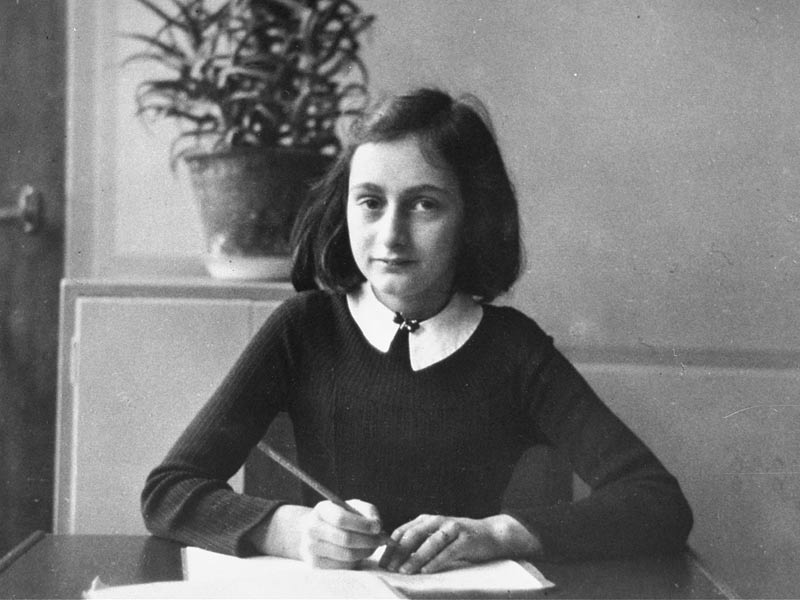
The 12 year old Anne Frank (1941) at her school desk
in Amsterdam, the Netherlands
in Amsterdam, the Netherlands
On July 15, 1944, the
hardly sixteen year old Anne Frank wrote in her Diary named Kitty: It is
utterly impossible for me to build my life on a foundation of chaos, suffering
and death. I see the world being slowly transformed into a wilderness, I hear
the approaching thunder that, one day, will destroy us too, I feel the
suffering of millions. After that she could confide to her Dearest Kitty only
on July 21 and August 1, 1944. She, along with her family and others, was captured from the
‘Secret Annexe’ where they had been hiding for two years, by the Nazi secret
police Gestapo on August 4, 1944. She was sent to the Bergen- Belsen
concentration camp and died there in March 1945, three months before her
16th birthday, and barely one month before the Bregen-Belsen was liberated by the Allied Forces.
We would shudder to
think the misery the girl might have suffered during those terrible seven
months. On 19th November 1942, Anne told
Kitty: Night after night, green and grey military vehicles cruise the streets.
They knock on every door, asking whether any Jews live there…I often see long
lines of good, innocent people, accompanied by crying children, walking on and
on, ordered about by a handful of men who bully and beat them until they nearly
drop. No one is spared. The sick, the elderly, children, babies and pregnant
women—all are marched to death. On 25th May 1944, she tells Kitty: …our only choice is to eat
fewer… We are going to be hungry, but nothing is worse than being caught. And
the worst thing happened on 4th August, 1944.
Posterity could know
the poignant story of Anne Frank, because she was such a gifted girl to write
it down. In each war, there are innumerable Anne Franks who perish. In each
communal riots there are people like Anne Frank who perish for the reasons that
are not theirs and not known to them.
In the 1947 Partition, in
the 1984 Delhi, in the 1993 Mumbai, in the 2002 Gujarat, in the 2012 Assam,
there might have been many Anne Franks and families who were annihilated. Among
the Tamils of Srilanka, among the Adivasis of Central India, among the
Palestenians suppressed by Israel and in all (civil)war torn countries of
Africa; Anne Franks and families have suffered and still suffer.
Why it happens? Are we
humans basically too narrow minded to accept our plurality and diversity? All
humans can’t follow one faith, one life style, one moral code, one dress code
and one food habit. As there are diverse ways of life and the very beauty of
Human Life and the Environment lies in the plurality, we desperately need to
stop trying to make others accept our ways and otherwise calling them the Other
and paving the ways to eternal confict and destruction.
Still, even sixty eight
years after, we can’t answer the pertinent questions asked by the little
girl called Anne Frank. On 3rd May 1944, she asked: Why are millions spent on the war each day,
while not a penny is available for medical science, artists or the poor? Why do
people have to starve when mountains of food are rotting away in other parts of
the world? Oh, why are people so crazy?
Why don’t we, the
grown-ups of the world, who write and talk theoratically on everything under
the sun incessantly, fail to understand the plain truth the girl tells us? She
says (on 3rd May,
1944): I don’t believe the
war is simply the work of politicians and capitalists. Oh no, the common man is
every bit as guilty; otherwise, people and nations would have rebelled long
ago! There is a destructive urge in people, the urge to rage, murder and kill.
And until all of humanity, without exception, undergoes a metamorphosis, wars
will continue to be waged, and everything that has been carefully built up,
cultivated and grown up will be cut down and destroyed…
Dear Anne, humanity
hasn't still undergone the metamorphosis you referred to 68 years ago. The
‘destructive urge’ still leads us and we still ‘rage, murder and kill’. Not only
that, we molest and rape too. On 5th April 1944, you told your Dearest Kitty that you wanted to go on living even
after your death. Oh! Dear girl, you live even after your death and it is
doubtless that you will continue to live as long as the human race exists. But
what is doubtful is how long the humans will be there on the surface of the
Earth with their ‘destructive urge to rage, murder and kill’.


Subscribe to:
Posts (Atom)